Who Needs to Take the IPPT? (Eligibility Rules for NSmen, NSFs & Pre-Enlistees)
The IPPT is required for many people in National Service, but the rules can feel unclear because they depend on service type, PES grade, and age or medical conditions. This page explains who must take the IPPT, who is exempt, and how the window system works. It also covers special cases like overseas study or work, so you can understand your own status before booking an attempt.
Use the IPPT CalculatorQuick IPPT Eligibility Summary
Mandatory for NSmen
Graded PES A, B1, B2, or C1 during an active IPPT window
Mandatory for NSFs
During full time National Service
Required for Pre-Enlistees
Only if graded PES A or B1 to qualify for reduced basic training duration
Not required for
Once age based, PES based, medical duration, or reserve exemptions apply
For Overseas
Being overseas does not remove the requirement unless formal approval is granted
Eligibility Overview Table
| Group | IPPT Required? | Key Notes |
|---|---|---|
| NSmen | Yes | PES A B1 B2 C1 plus active window |
| NSFs | Yes | Part of full time service |
| Pre Enlistees | PES A B1 only | For eight week reduction |
| PES B3 B4 C2 E | No | Exempt |
| Officers aged 45 and above | No | Age based exemption |
| WOSEs aged 40 and above | No | Age based exemption |
| MINDEF Reserve | No | Ends after MR posting |
What the IPPT Is and Who It Applies To?
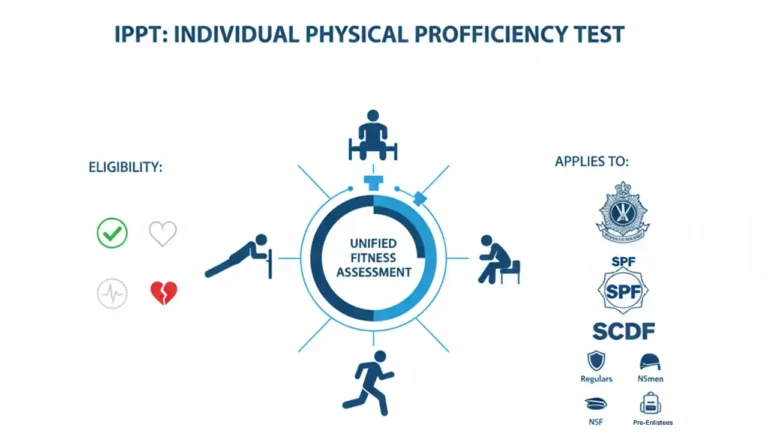
The IPPT calculator score is a three-station fitness assessment using push ups, sit ups, and a 2.4 km run. Most NSmen in PES A, B1, B2, or C1 must attempt it once each IPPT window unless medically or administratively exempt.
The Individual Physical Proficiency Test is a physical fitness assessment used across Singapore’s uniformed services. It applies to eligible personnel in the Singapore Armed Forces, Singapore Police Force and Singapore Civil Defence Force. Eligibility is based on service status and medical classification.
The test follows the same structure for all eligible participants. Push ups measure upper body strength, sit ups measure core endurance, and the run measures aerobic fitness. Each station contributes to the official 100 point scoring framework. Age band and gender affect how performance converts into points, but the stations themselves do not change.
-
Purpose of the IPPT
The IPPT supports National Service by confirming basic fitness for training and operational duties. It checks strength and endurance in a controlled format. The scoring framework applies equally across age bands and service groups to ensure consistent assessment.
-
Services and Personnel Covered
The assessment applies to personnel serving in SAF, SPF, and SCDF. This includes NSmen, full time NSFs, eligible Pre Enlistees, and Regulars who remain subject to service fitness requirements. The same station structure is used across all uniformed branches.
Core Eligibility Rules for IPPT
IPPT eligibility depends on service status, PES grade, and compliance window rules. NSmen graded PES A, B1, B2, or C1 must attempt the test within their IPPT window each year. NSFs take the test during full time service. Pre Enlistees only require IPPT if graded PES A or B1. Some groups qualify for exemptions based on medical duration, PES classification, age, or reserve status.
Key eligibility points
Eligibility is linked to service status, PES grade, and IPPT window
NSmen requirement applies only to PES A B1 B2 C1
NSFs take IPPT during full time service
Pre Enlistees take IPPT only if graded PES A or B1
Exemptions apply through medical duration, age, reserve posting, or PES downgrade
Overseas study or work does not remove the requirement without approval
Eligibility rules follow National Service obligations and medical classification. While criteria differ by group, the scoring structure and required stations remain the same. Eligibility continues even when overseas unless a formal exemption or deferment is approved.
Eligibility Rules
If NSF → IPPT required.
If NSman AND PES A/B1/B2/C1 → must attempt.
If Pre-Enlistee AND PES A/B1 → required for reduction.
If PES B3/B4/C2/E → exempt.
If Officer ≥45 or WOSE ≥40 → exempt.
If medical exemption ≥6 months continuous OR ≥9 months cumulative → exempt.
NSmen (Operationally Ready National Servicemen)
NSmen must complete one valid IPPT attempt within each IPPT window. This responsibility is not tied to a SAF100 notification. Each NSman is expected to track his own compliance window. The test may be taken during In Camp Training or at an approved Fitness Conditioning Centre.
NSmen graded PES A, B1, B2, or C1 are required to take IPPT. These grades confirm medical suitability for the standard three station assessment. The scoring tables adjust for age but not for PES within these required groups.
PES categories that must take IPPT
PES A
PES B1
PES B2
PES C1
PES categories exempt from IPPT
PES B3
PES B4
PES C2
PES E
NSFs (Full Time National Servicemen)
NSFs take IPPT during full time service as part of training and readiness checks. The assessment is conducted during Basic Military Training and later service phases. The same stations and scoring framework apply as for NSmen.
Pre Enlistees
Pre Enlistees take IPPT only if graded PES A or B1. The result is used to determine eligibility for reduced basic training duration. Those graded PES B other than B1, PES C, or PES E are not required to take IPPT before enlistment.
You can check your own eligibility and score using our IPPT Calculator.
Check Your IPPT ScoreEligibility by Physical Employment Standard (PES)
PES grading determines whether an individual must take IPPT. It reflects long term medical suitability for the standard three station assessment. PES A, B1, B2, and C1 require participation. PES B3, B4, C2, and E are exempt.
The PES framework is used across enlistment, posting, and fitness assessment systems. It aligns assessment demands with medical status and is applied consistently across services.
PES to IPPT Requirement Table
| PES | IPPT Required? | Notes |
|---|---|---|
| A | Yes | Fully eligible |
| B1 | Yes | Fully eligible |
| B2 | Yes | Required |
| C1 | Yes | Required |
| B3 | No | Exempt |
| B4 | No | Exempt |
| C2 | No | Exempt |
| E | No | Exempt |
Why PES Determines Eligibility?
PES categories match medical capacity to physical assessment demands. Required categories are medically cleared for the full IPPT format. Exempt categories reflect conditions that limit participation. PES classification remains the primary factor for IPPT obligation.
IPPT Window and Frequency Rules
The IPPT window is a defined twelve month period during which eligible personnel must attempt the test. NSmen usually follow a birthday based window, while some Home Team schemes use a financial year window. Multiple attempts are allowed within the window, and only the most recent valid result is recorded.
The window system creates a predictable compliance cycle. Tracking the window is important because missing it can lead to defaulting. While window formats differ, the obligation to make a valid attempt remains the same.
What Is an IPPT Window?
An IPPT window is the official period when a valid attempt must be recorded. The window is tied to service category and determines compliance timing. Responsibility for monitoring the window lies with the individual.
Birthday Based Window (SAF)
For SAF NSmen, the window starts on the birthday after the Operationally Ready Date and ends the day before the next birthday. This creates a rolling annual cycle.
Example
ORD on 10 June
Birthday on 20 August
Window runs from 20 August this year to 19 August next year
Financial Year Window (SPF SCDF)
Some Home Team schemes use a fixed window from 1 April to 31 March. Although the timing differs, eligibility rules and scoring remain aligned.
How Many Attempts Are Allowed
There is no fixed limit on attempts within the window. Only the most recent valid attempt is used for compliance and qualification.
Exemptions from IPPT
IPPT exemptions apply through PES classification, age or rank thresholds, sustained medical conditions, or posting to the MINDEF Reserve. Individuals graded PES B3, B4, C2, or E are exempt. Temporary exemptions require formal documentation, and age based exemptions apply to officers aged 45 and above and WOSEs aged 40 and above.
Exemptions align fitness requirements with medical or administrative factors. They apply only after formal classification. Exemptions within a window must meet defined duration rules.
PES Based Exemptions
Permanent downgrades to PES B3, B4, C2, or E remove the IPPT requirement. These classifications indicate unsuitability for the standard assessment format.
Age and Service Based Exemptions
Officers aged 45 and above and WOSEs aged 40 and above are exempt from IPPT. Exemption also applies once an individual is placed in the MINDEF Reserve.
Medical Exemptions Within a Window
Medical exemption applies when documented medical status meets one of the following:
- At least six months of continuous medical exemption
- Nine months of cumulative medical exemption within the same window
Short term medical certificates alone do not meet exemption criteria.
Special Situations and Clarifications
Special situations such as overseas work or study do not remove IPPT requirements by default. Exemptions require approval and are not based on location alone. Regulars remain subject to service fitness requirements, and exemption from IPPT does not remove other fitness obligations.
These clarifications help avoid misunderstandings. Overseas assignments follow formal deferment or exemption processes. Regulars follow service policy using the same assessment structure.
Overseas Work or Study
Overseas presence does not cancel IPPT obligations. Eligibility remains active until a deferment or exemption is approved.
IPPT for SAF Regulars
Regulars are subject to IPPT under service policy. The same stations and scoring apply as for NSmen and NSFs.
What Happens After Exemption
Once approved, the IPPT requirement ends for that window or permanently, depending on status. Other fitness standards may still apply.
Administrative Requirements Linked to Eligibility
Administrative rules include attire standards, medical screening, and participation guidance for those on medication. These rules support safety and consistency during assessment.
Fitness centres may turn participants away if attire does not meet guidelines. Medical screening applies in specific cases to confirm suitability.
Attire Requirements for IPPT
Permanent downgrades to PES B3, B4, C2, or E remove the IPPT requirement. These classifications indicate unsuitability for the standard assessment format.
Accepted attire
- Knee length shorts or above knee tights
- Running shorts tights or track pants
- Short sleeve or sleeveless top
- Running shoes
- White black or dark coloured socks
Only approved attire is accepted. Participants wearing other clothing may need to rebook.
Pre IPPT Medical Screening
Medical screening may apply for certain age groups or recent medical changes. Screening confirms readiness for the three stations.
Attending IPPT While on Medication
Medication does not automatically exempt participation. Clearance may be needed depending on the medication and condition.
IPPT and ORNS Contribution (NSmen Only)
For NSmen, IPPT calculator score may count toward ORNS contribution depending on where the test is taken. Attempts at Fitness Conditioning Centres contribute half a day for the first three attempts. Attempts during In Camp Training do not add ORNS days.
These rules apply only to NSmen. Pay and contribution treatment depends on the assessment location.
ORNS and Pay Implications
| IPPT Mode | ORNS Contribution | Notes |
|---|---|---|
| FCC IPPT | Half day for first three | Pay applicable |
| ICT IPPT | None | Counted within ICT |
Non Compliance and Defaulting
Defaulting occurs when a required individual does not record a valid attempt within the window and does not qualify for exemption. Consequences may include investigation, review, and mandatory NS FIT in the next window.
Monitoring compliance helps avoid defaulting. Early booking and awareness of window timing reduce risk.
How to Avoid Defaulting
- Book early within the window
- Track window dates
- Use FCC or ICT options
- Confirm medical status
What Counts as Defaulting
Defaulting includes no attempt within the window or failure to meet requirements without exemption.
Consequences of Defaulting
Consequences may include investigation and mandatory NS FIT. Outcomes depend on official records
Common Misunderstandings (Myth vs Reality)
Misunderstandings often come from confusion about PES, overseas status, or medical documents. Eligibility depends on service status and official classification.
Myth: PES B always requires IPPT
Reality: Only PES A B1 B2 C1 are required
Myth: Overseas posting removes the requirement
Reality: Approval is required
Myth: All Pre Enlistees must take IPPT
Reality: Only PES A or B1
Myth: Medical MC grants exemption
Reality: Formal classification and duration rules apply
Frequently Asked Questions (Eligibility Focused)
These answers reflect publicly available guidance. Outcomes depend on official records.
How to Check Your IPPT Eligibility?
Eligibility can be checked by reviewing PES status, service category, and IPPT window on official portals. Confirm exemption or deferment status before booking.
Steps
- Review PES status
- Confirm IPPT window
- Check exemption or deferment records
Where to check:
Log in to NS Portal → eServices → IPPT / NS FIT to view your PES, IPPT window, exemption records, and booking options. If any information appears incorrect, submit an update request through the relevant eService or your unit’s administrative channel.
Once you’ve confirmed your IPPT eligibility, these guides will help you understand what happens next.
Sources and Accuracy Note
This page is based on publicly available guidance from MINDEF, CMPB, AskGov, and NS Portal. Rules may change with official updates. Final outcomes depend on authorised records and assessments.
If you already know your eligibility and want to check your own IPPT score or see how close you are to the passing mark, you can use the IPPT Calculator.