If you just received your enlistment letter, you’re probably hearing a lot of new terms thrown around. IPPT. PES. BMT. Training reduction. 61 points.
And if we’re being honest, most people don’t fully understand what these actually mean. They just know one thing: somehow this test might shorten National Service.
It can feel confusing. A bit stressful too.
Students usually wonder, “Do I really need to take this?”
Parents usually ask, “Is this important for my son’s enlistment?”
Let’s slow everything down and break it properly.
First, What Do All These Terms Even Mean?
Before we talk about pre enlistee IPPT, let’s decode the basic terms in simple language.
What Is NS?
NS stands for National Service. In Singapore, most male citizens and permanent residents serve full-time military or uniformed service when they turn 18 or after finishing school.
What Is BMT?
BMT means Basic Military Training.
This is the first phase of National Service. It’s where recruits go through physical training, discipline routines, field training, and military basics.
Some recruits go through a longer training phase. Some may qualify for a shorter one. That’s where IPPT comes in.
What Is IPPT?
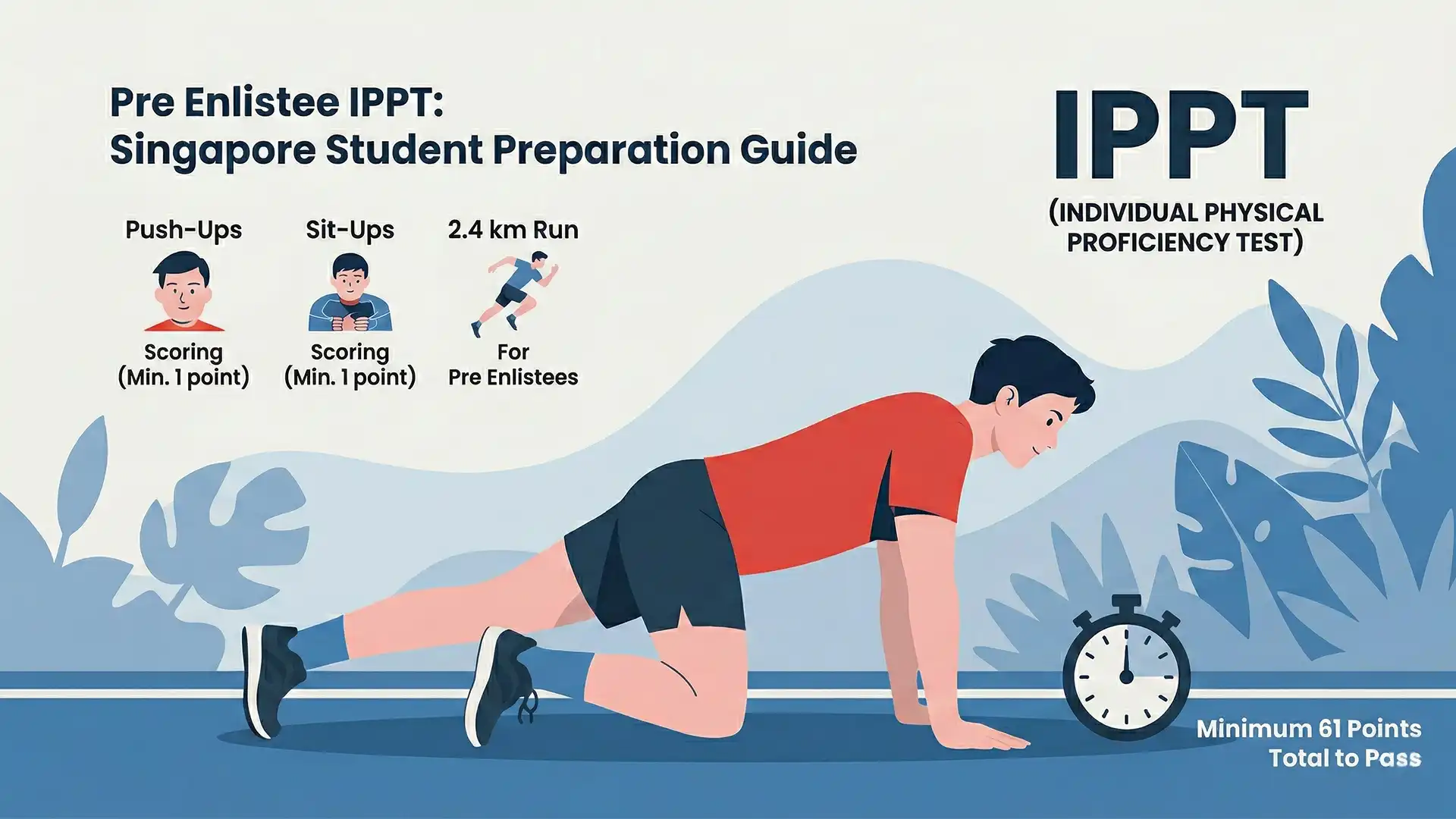
IPPT stands for Individual Physical Proficiency Test.
It’s a fitness test used by the Singapore Armed Forces. It measures:
- Push-ups
- Sit-ups
- 2.4 kilometre run
You are given points based on your performance. The higher your score, the better your result.
What Is PES?
PES stands for Physical Employment Status.
It is your medical classification. After medical screening, you are graded based on your physical condition.
For pre enlistee IPPT, the key grades are:
- PES A
- PES B1
Only these groups qualify for possible BMT reduction if they pass the required score.
what is pre enlistee iPPT?
Now that the terms are clear, here’s the simple explanation.
The pre enlistee IPPT is the same fitness test, but taken before you officially start full-time National Service.
If you score at least 61 points and you are graded PES A or B1, you may qualify for a shorter Basic Military Training period.
That’s why many students consider taking it.
Not because it’s compulsory.
But because it can save weeks of training time.
What Is the Pre Enlistee IPPT?
The pre enlistee IPPT (Individual Physical Proficiency Test) is a fitness assessment taken before starting full-time National Service (NS) in Singapore.
It is meant for those who are medically graded PES A or B1, and the biggest benefit is this:
If you score 61 points or more, you may qualify for a shorter Basic Military Training (BMT) duration.
The test consists of three stations:
- Push-ups
- Sit-ups
- 2.4 km run
Each station gives you points based on your performance. Your total score determines whether you pass and whether you qualify for training reduction.
If you want to understand how points are calculated across age groups and repetitions, refer to the full breakdown in our IPPT Scoring System guide.
Who Should Take the Pre Enlistee IPPT?
You should strongly consider taking it if:
- You are graded PES A or B1
- You are physically capable of training
- You want to reduce your BMT duration
If you are graded PES B2 and below, the result typically does not reduce your training duration.
For many students, this is an opportunity. You’re still young, likely active from school sports, and have time to train before enlistment. Waiting until BMT to “get fit” often makes things harder.
Should You Take the Pre Enlistee IPPT?
| Question | If Yes | If No |
|---|---|---|
| Are you graded PES A or B1? | You are eligible for possible BMT reduction. | Training reduction likely does not apply. |
| Do you have 4 to 8 weeks before enlistment? | Enough time to train properly. | Consider preparing first before booking. |
| Are you medically fit to exercise? | Safe to begin structured training. | Consult a doctor before attempting. |
| Are you willing to train consistently? | Good chance of reaching 61 points. | Results may not improve significantly. |
General rule:
If most of your answers fall under the Yes column, taking the pre enlistee IPPT is usually worthwhile.
How Pre Enlistee IPPT Results Affect BMT?
Here’s the part most people care about.
If you score 61 points or more, and you meet the eligibility requirements, you may skip the Physical Training Phase in BMT, effectively reducing your training duration by about 8 weeks.
But here’s what government sites don’t explain clearly:
- 61 points is not extremely high.
- It’s achievable with consistent training.
- Borderline scores such as 58 to 60 are frustrating because they don’t qualify.
This is why understanding your score potential before booking matters.
If you’re unsure how close you are to 61 points, use the calculator on our homepage and compare it with the criteria explained in the IPPT Scoring System article.
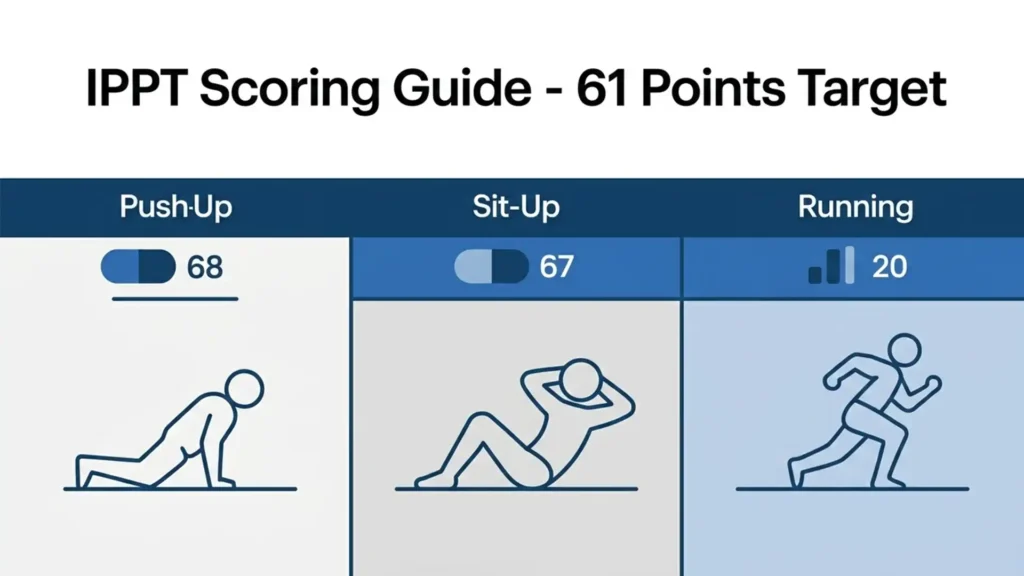
What 61 Points Roughly Looks Like (Example for 18-Year-Old)
| Component | Approximate Target for around 61 Points | Why It Matters |
|---|---|---|
| Push-ups | 30 to 35 reps | Builds base points quickly |
| Sit-ups | 30 to 35 reps | Helps balance overall score |
| 2.4 km Run | 11:30 to 12:00 minutes | Biggest potential score swing |
Important Note:
You do not need to max out any single station. Many students reach 61 by performing consistently across all three components rather than excelling in just one.
For exact age-based scoring tables and point breakdowns, refer to the IPPT Scoring System guide.
How to check your pre enlistee iPPT results?
After completing the test, your results are typically reflected in your NS portal records.
What your result means:
- Below 61 points, you proceed with standard BMT duration.
- 61 points and above, you may qualify for reduced training subject to PES and timing rules.
Results are generally valid for a limited period before enlistment. If you take the test too early and your enlistment date is much later, validity may become an issue.
This is why timing matters. Our guide on IPPT Window Timing & Annual Requirements explains how result validity works in more detail.
Should You Retake the Pre Enlistee IPPT?
This depends on your score.
If you score:
- 30 to 45, focus on structured training before reattempting.
- 50 to 60, you’re close. A targeted improvement plan can push you past 61.
- 61 or more, retaking is usually unnecessary unless you’re aiming higher for personal reasons.
Many students panic after scoring 55 to 58. The truth is, that’s already close. Improving your 2.4 km timing by even 30 to 45 seconds can make a significant difference.
Practical Tips to Improve Your Pre Enlistee IPPT Score
Government pages tell you what the test is. They don’t tell you how to prepare smartly. You can find a more detailed breakdown in our guide on how to ace your IPPT in 7 easy steps. Here’s what actually helps:
Here’s what actually helps:
1. Focus on the 2.4 km Run First
The run often contributes the biggest score jump potential. Improving endurance gives you more points than small push-up increases.
Train 3 times per week:
- 1 long slow jog
- 1 interval session
- 1 tempo run
Even 4 to 6 weeks of consistent training can improve your time meaningfully. Don’t forget that the run is often a mental battle; learning how to pace your thoughts is just as important as pacing your legs.
2. Train Push-Ups and Sit-Ups with Volume, Not Ego
Don’t just test max reps once a week.
Instead:
- Do 3 to 4 sets at 70 to 80 percent of max reps
- Train every other day
- Focus on form consistency
Small daily improvements compound quickly.
3. Book at the Right Time
Don’t book too early if you haven’t trained.
Give yourself:
- At least 4 to 8 weeks of prep
- Enough buffer before enlistment
Poor planning leads to unnecessary stress.
4. Don’t Ignore Recovery
Many pre-enlistees overtrain in panic mode.
Sleep, hydration, and rest days matter. Fatigue affects run timing and muscular endurance significantly.
Common Mistakes Students Make
- Booking without checking current fitness level
- Ignoring run training and only doing push-ups
- Misunderstanding score requirements
- Assuming “I’ll just get fit in BMT”
You can avoid these mistakes with a structured plan and understanding how scoring works.
If you’re worried about what happens if you don’t pass, read our IPPT Fail Guide to understand what follows after unsuccessful attempts.
Frequently asked questions (fAQs)
No. It is optional. But taking and passing it can shorten your BMT duration if you qualify.
61 points is the key benchmark if you want to reduce training duration for eligible PES grades.
Yes, you may retake within the allowed window before enlistment, subject to booking availability.
For someone moderately active, it is achievable with 1 to 2 months of focused preparation.
If medically eligible and physically ready, yes. It can reduce training time and build confidence before enlistment.
Conclusion
At the end of the day, the pre enlistee IPPT isn’t something to panic over. It’s simply an option that’s available before enlistment. Some people take it. Some don’t. What matters more is understanding what it actually does and deciding based on your own situation.
If you’re medically fit and have time to train, aiming for 61 points is realistic for most students. You don’t need to be an athlete. You just need consistency. And even if you don’t hit the score the first time, it’s not the end of anything. NS will still happen. Training will still build you up.
The key is going in informed instead of confused. Once you understand how scoring works and what it means for your BMT, the whole process feels a lot less intimidating.