TL;DR
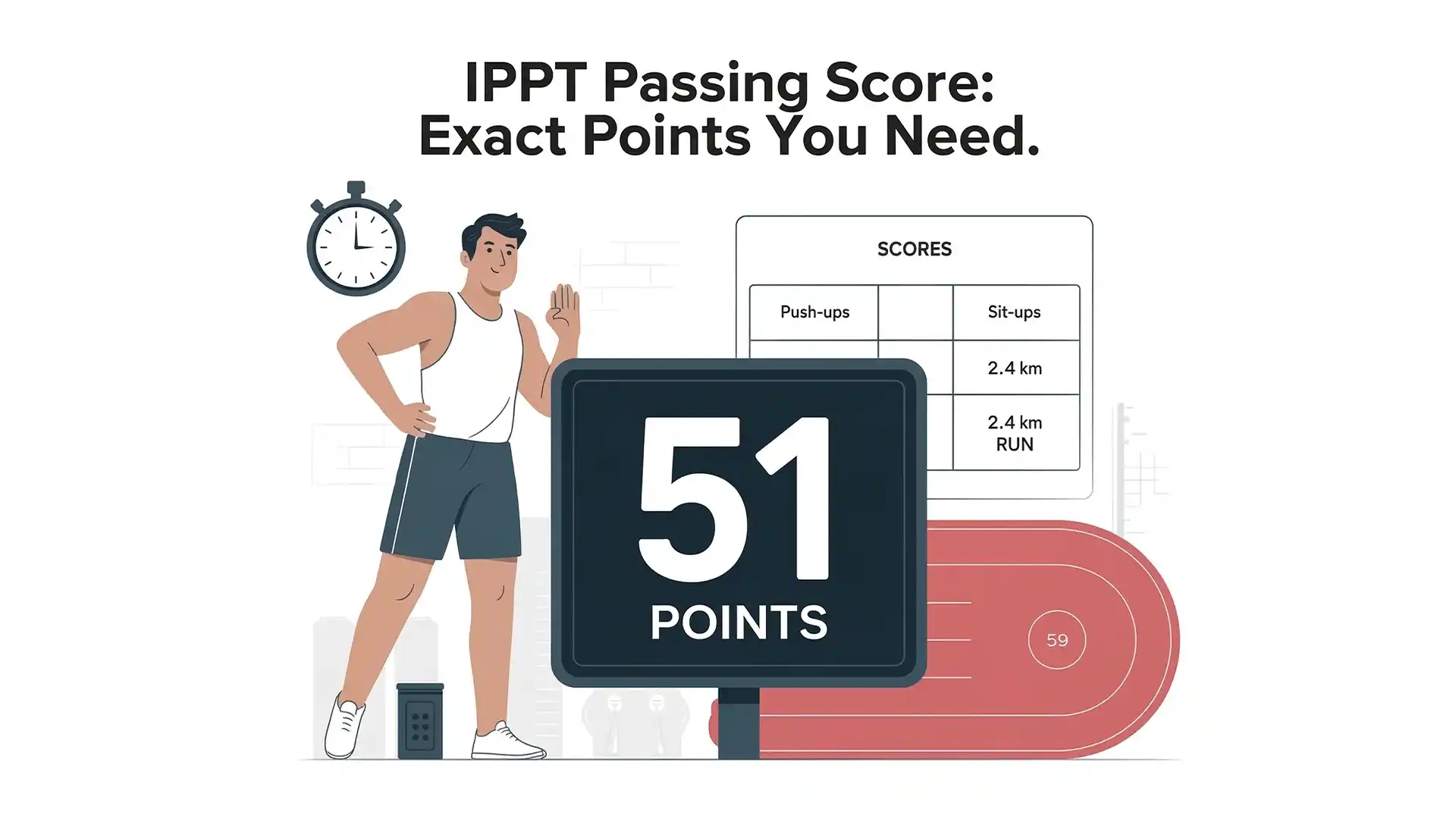
The IPPT passing score for most NSmen is 51 points, calculated from push-ups, sit-ups, and the 2.4 km run using official scoring tables. You must also score at least one point in every station, otherwise the attempt will not count as a pass. If you want to know whether your current fitness level is enough, check your expected IPPT result using the IPPT calculator.
To pass the IPPT fitness test, NSmen must reach the IPPT pass mark of 51 points. The total score comes from push-ups, sit-ups, and the 2.4 km run. Each station gives points based on official scoring tables for your age band. You must also earn at least one point in every station, otherwise the test will still be counted as a failure.
What Is the IPPT Passing Score?
The minimum IPPT passing score is 51 points. Your final score comes from the points earned in push-ups, sit-ups, and the 2.4 km run.The IPPT fitness test is part of the Singapore Armed Forces (SAF) annual fitness system. If you are unsure whether you are actually required to take IPPT in your current service category, read the IPPT eligibility guide before focusing on target points.
The IPPT fitness test checks several parts of your fitness at the same time. Push-ups measure upper-body strength, sit-ups test core endurance, and the run measures cardiovascular endurance.
According to MINDEF guidance on the National Service portal, NSmen must reach the minimum score within the official scoring tables to pass the yearly IPPT requirement.
If you want to understand how points from each station are added together, how pass marks work, and how awards are determined, see the full IPPT scoring system guide.
Do You Need Points in Every Station?
Yes. To pass IPPT you must earn at least one point in every station. Even if your total score is higher than 51, the test will not count as a pass if one station receives zero points.
This rule ensures that NSmen maintain a basic level of fitness in all parts of the test. The system is designed so that strength, endurance, and running ability all matter.
For example, a very fast run cannot make up for failing push-ups or sit-ups completely. You still need some performance in every exercise to pass the IPPT fitness test.
How IPPT Points Are Calculated?
For a complete explanation of how station points, pass thresholds, and total scores work together, refer to the IPPT scoring system guide.
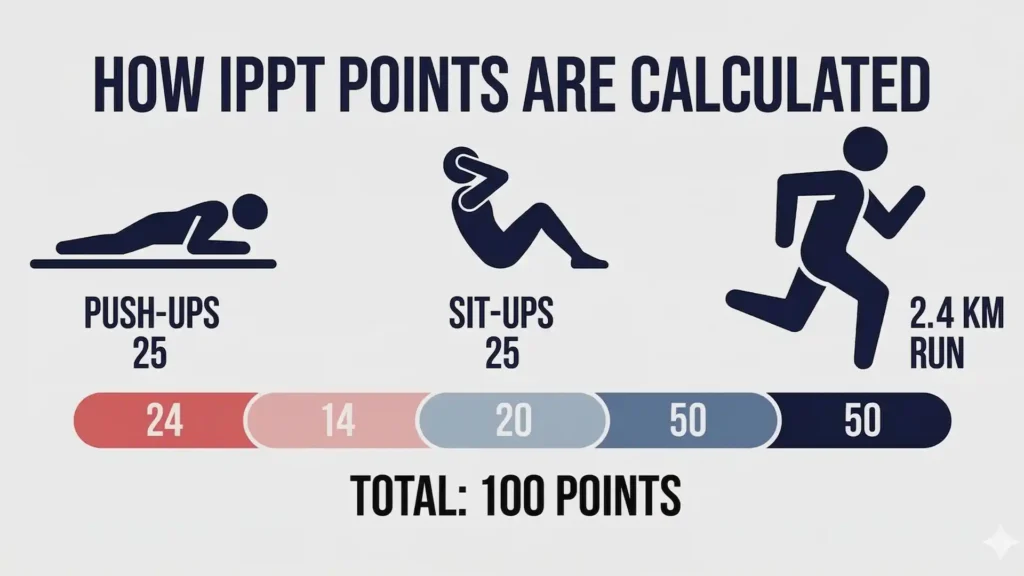
| Station | Maximum Points |
|---|---|
| Push-Ups | 25 |
| Sit-Ups | 25 |
| 2.4 km Run | 50 |
The run has the highest number of possible points. Because of this, improving your run timing can raise your overall IPPT result quite quickly.
However, strength exercises still matter because at least one point is required in push-ups and sit-ups.
To see the exact repetition and timing requirements for your age group, check IPPT scoring tables for men.
Push-Ups Scoring
Push-ups measure upper-body endurance. The more correct repetitions you complete, the more points you receive according to the scoring table.
The exact numbers vary slightly depending on your age band. Regular push-up training can quickly improve your score because small increases in repetitions often add extra points.
Sit-Ups Scoring
Sit-ups measure core endurance. Points increase as your repetition count increases during the test.
Many NSmen find sit-ups easier to improve through regular practice. Even a few extra repetitions can help raise your total IPPT score.
2.4 km Run Scoring
The 2.4 km run measures endurance and stamina. Faster run times correspond to higher points in the scoring table.
Because the run contributes up to fifty points, improving your pacing or endurance can increase your overall score more than any other station.
Can You Pass IPPT With 50 Points?
No. A score of 50 points is still considered a failure. The official IPPT pass mark is 51 points, and the scoring system does not round scores up.
This situation happens quite often when someone performs well in two stations but falls slightly short in the third. For example, a strong run and decent sit-ups may still produce a total of only fifty points.
If your expected score is close to the passing threshold, improving one exercise slightly may be enough to reach the required score.
Example Score Combinations That Pass
Different combinations of performance can reach the passing score. The exact numbers depend on your age band, but the examples below show typical passing results.
| Push-Ups | Sit-Ups | Run Time | Total Points | Result |
|---|---|---|---|---|
| 30 | 30 | 12:00 | 52 | Pass |
| 35 | 32 | 12:20 | 53 | Pass |
| 28 | 30 | 11:45 | 51 | Pass |
These examples show that there are several ways to reach the minimum score. Some NSmen rely more on strong running performance, while others earn more points from strength exercises.
You can estimate your own IPPT result using the IPPT score calculator . Enter your expected repetitions and run timing to see whether you are likely to pass.
How Many Push-Ups Do You Need To Pass IPPT?
There is no single push-up number that guarantees a pass. Your final result depends on the combined points from push-ups, sit-ups, and the run.
However, reaching a moderate number of push-ups usually provides enough points to support the total score. When combined with reasonable sit-ups and a decent run time, this often helps reach the passing mark.
For the exact repetition requirements for each age band, refer to IPPT scoring tables for men .
What Happens If You Fail IPPT?
Failing IPPT means your score did not reach the minimum requirement or you did not earn points in every station. In this situation, the system may require follow-up training sessions depending on your unit.
Many NSmen improve their score after several weeks of focused training. Strength exercises and interval running are common ways to increase repetition counts and improve run timing.
How To Improve Your IPPT Score?
Improving your score usually comes from consistent training over several weeks. Small improvements in repetitions or run timing can raise the total score.
Some common ways to improve include:
• regular push-up and sit-up practice
• interval running to improve endurance
• maintaining a steady weekly training routine
If you want a more practical improvement plan, read our guide on how to ace your IPPT in 7 easy steps for a simpler training approach.
What To Do Before Your Next Attempt?
Before booking your next IPPT attempt, check the scoring tables for your age band so you understand the target numbers.
Next, estimate your expected score using the IPPT score calculator . This helps you decide whether to attempt the test soon or continue training.
Most NSmen aim slightly above the IPPT pass mark so they do not fail by a single point.
FAQ
The minimum IPPT passing score for NSmen is 51 points based on official scoring tables.
The IPPT pass mark is 51 points, calculated from push-ups, sit-ups, and the 2.4 km run using official scoring rules. For the full breakdown, check the IPPT scoring system guide.
Yes. You must earn at least one point in push-ups, sit-ups, and the run.
No. A total of 50 points is still considered a failure because the minimum passing score is 51.
The number depends on your age band and performance in the other stations. The scoring tables determine how many repetitions correspond to each point.
The run gives the highest number of points, but you still need points in the strength stations to pass.
Enter your expected push-ups, sit-ups, and run timing into the IPPT calculator. The calculator will estimate your total points.