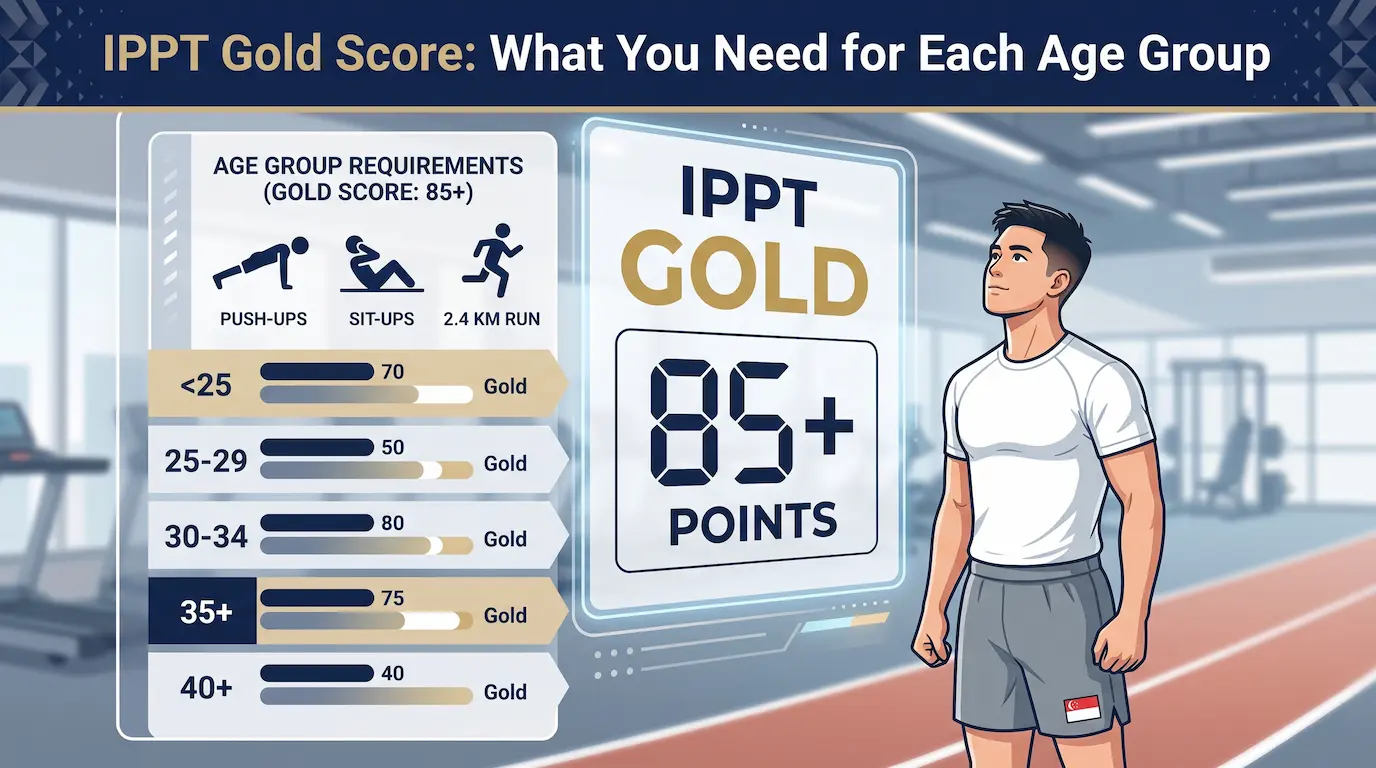
For many NSmen, Gold feels like something other people achieve. Maybe you used to be fit during your NSF days but have since gained weight, become busy with work, or started a family. Maybe you’ve failed IPPT multiple times and now see Gold as completely out of reach. The reality is that many NSmen who eventually achieve Gold don’t start as top performers. They start exactly where many people are today: struggling to pass, frustrated with their 2.4km timing, or wondering whether they have left it too late.
The encouraging part is that real fail-to-gold transformations happen every year. Across NS communities, ordinary working adults, fathers, and even repeat IPPT failures have steadily improved their scores through consistency rather than extreme training. These stories show that Gold is usually not the result of talent. It is often the result of small improvements made over months, not weeks. If you’re currently trying to figure out how far away Gold really is, you can calculate your current IPPT score and use these journeys as a benchmark.
Key Takeaway
- Most fail-to-gold transformations take 3–12 months
- The 2.4km run usually offers the biggest scoring gains
- Consistency matters more than extreme workouts
- Many successful NSmen are working adults and fathers
- Most Gold achievers progress through Pass → Silver → Gold
Can You Really Go From Failing IPPT to Gold?
Yes. Many NSmen improve from failing IPPT to achieving Gold by gradually increasing their push-up and sit-up scores while focusing heavily on improving their 2.4km run timing. For most people, the journey takes several months rather than a few weeks, but consistent training can produce significant improvements over time.
Why So Many NSmen Think Gold Is Impossible
Many NSmen, especially Operationally Ready National Servicemen (ORNS) balancing careers and family commitments, assume Gold is reserved for naturally athletic people. Once work deadlines, family responsibilities, and age start becoming factors, it becomes easy to believe that simply passing is good enough.
Several of the NSmen featured in this article once felt exactly the same way. Some had failed repeatedly. Others had spent years stuck at Pass or Silver. A few had not achieved Gold even during their active service days.
What changed was not their genetics. What changed was their approach to training, structure, and long-term planning.
Many also discovered that much of their stress came from uncertainty rather than fitness itself. Understanding the pressure many NSmen feel before IPPT often helps put the challenge into perspective.
After reviewing NSmen discussions, IPPT scoring requirements, and common improvement patterns, one theme appears repeatedly: Gold is rarely achieved through extreme training. Most successful NSmen improve gradually rather than trying to transform their fitness in a few weeks.
Story #1 – The Busy Father Who Trained Before Sunrise
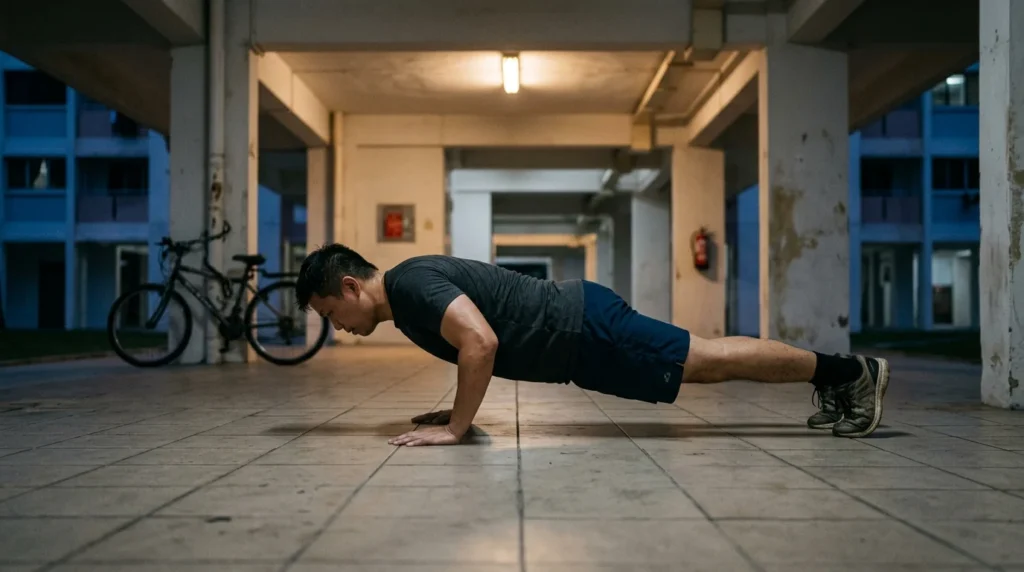
Before
- Age: 36
- Occupation: Project Manager
- Family: Married with two children
- Starting Score: 54 points (Fail)
- Biggest Challenge: No time after work
Like many fathers, he found that evenings belonged to his family. Gym sessions constantly got postponed, and every failed IPPT reinforced the belief that Gold was unrealistic.
Turning Point
Instead of chasing long workouts, he committed to three 30-minute morning sessions each week. His schedule looked like this:
- Tuesday: Easy run
- Thursday: Push-ups and sit-ups
- Saturday: Longer run
He followed a simple weekly training routine over 8 months, prioritising consistency over intensity.
Result
| Metric | Before | After |
|---|---|---|
| Push-Ups | 20 | 46 |
| Sit-Ups | 25 | 48 |
| 2.4km Run | 14:45 | 10:55 |
| Score | 54 | 86 (Gold) |
Lesson Learned: A fixed weekly schedule — even short sessions — beats an ambitious plan that keeps getting postponed.
Story #2 – The Office Worker Who Fixed His 2.4km Timing
Before
- Age: 31
- Occupation: Finance Executive
- Starting Score: 61 points
His statics were already decent. The problem was his run. His 2.4km timing sat around 14 minutes and had barely improved for years.
Turning Point
Instead of doing random runs, he focused specifically on pace development over a 5-month period:
- Intervals
- Tempo runs
- Weekly long run
He also spent time mastering the mental side of the 2.4km run. To track his progress, he regularly trained and tested himself on routes similar to those used at Maju FCC, helping him become more comfortable with race pacing and effort management.
Result
| Metric | Before | After |
|---|---|---|
| Push-Ups | 40 | 45 |
| Sit-Ups | 42 | 48 |
| 2.4km Run | 14:03 | 10:32 |
| Score | 61 | 87 (Gold) |
Lesson Learned: When your statics are already close to target, the run is usually where the fastest points come from.
Story #3 – The Repeat Failure Who Finally Broke Through
Before
- Age: 34
- Starting Score: Multiple failures across several years
He had become convinced that failure was simply his normal outcome. Every new IPPT window felt like a repeat of the previous one.
Turning Point
Rather than focusing on Gold immediately, he focused on passing first. He used recovering after another failed IPPT attempt as a mindset framework and treated each improvement as a small victory. He also attended NS FIT sessions consistently, using them as a structured way to rebuild fitness and stay accountable throughout the year.
Result
Progression:
- Year 1: Fail
- Year 2: Pass
- Year 3: Silver
- Year 4: Gold
Lesson Learned: Aiming for the next tier instead of Gold outright makes the goal feel achievable, and the tiers compound over time.
Story #4 – The Silver Performer Who Needed Just a Few More Points
Before
- Age: 29
- Starting Score: 78–82 points consistently
This is one of the most common situations among NSmen. He was already close to Gold but never quite reached it.
Turning Point
After understanding the Silver scoring threshold and studying what Gold requires for his age group, he realized he only needed a small improvement in one station. Instead of improving everything, he targeted the run.
Result
| Metric | Before | After |
|---|---|---|
| Push-Ups | 48 | 50 |
| Sit-Ups | 48 | 50 |
| 2.4km Run | 11:30 | 10:55 |
| Score | 82 | 86 (Gold) |
Lesson Learned: Know exactly how many points you’re short of Gold before deciding what to train — sometimes it’s one station, not a full overhaul.
Story #5 – Understanding the Numbers Changed Everything
Before
- Age: 32
- Occupation: Engineer
He trained hard but never tracked his points. As a result, he often spent effort improving areas that contributed little to his overall score.
Turning Point
He started understanding where the points come from and began calculating his exact score after every training cycle over 6 months. This helped him identify weaknesses immediately.
Result
His score improved steadily because every training block became more targeted.
Lesson Learned: Tracking your score after every session tells you where to spend your limited training time — you cannot improve what you do not measure.
Story #6 – The Late 30s NSman Who Refused to Settle
Before
- Age: 39
- Starting Score: Pass
Many people around him told him to be satisfied with passing. He disagreed.
Turning Point
He stopped comparing himself to younger NSmen and focused on steady, planned progress. He also spent time planning around his annual IPPT window, giving himself enough time to improve gradually across several months rather than relying on last-minute preparation.
Result
After eight months of consistent training:
| Metric | Before | After |
|---|---|---|
| Push-Ups | 28 | 45 |
| Sit-Ups | 32 | 47 |
| 2.4km Run | 13:40 | 11:00 |
| Score | Pass | Gold |
Lesson Learned: Age changes the timeline, not the possibility — starting earlier in the IPPT window gives older NSmen the runway they need.
Story #7 – First Gold Before MR

Before
- Age: 42
- Occupation: Operations Supervisor
- Starting Score: Fail (2.4km run at 15:10)
He had failed IPPT with a slow run timing and, like many older NSmen, assumed his window for Gold had closed as he approached MR (Mid-Range/liability) status.
Turning Point
He increased his weekly mileage gradually and remained patient through several years of incremental progress, rather than chasing a fast result in one training cycle. He focused on completing his annual IPPT requirements each year while building long-term aerobic fitness.
Result
| Metric | Before | After |
|---|---|---|
| 2.4km Run | 15:10 | 9:42 |
| Score | Fail | 88 (Gold) |
| Timeframe | — | Several years, achieved before MR |
Lesson Learned: Some of the biggest transformations aren’t built in one training block — they’re built one IPPT window at a time, over years.
What Changed Across Every Fail-to-Gold Journey?
| Story | Starting Point | Final Score | Time Taken |
|---|---|---|---|
| Busy Father | Fail | Gold | 8 Months |
| Office Worker | Pass | Gold | 5 Months |
| Repeat Failure | Multiple Fails | Gold | 4 Years |
| Silver Performer | Silver | Gold | 3 Months |
| Engineer | Pass | Gold | 6 Months |
| Late 30s NSman | Pass | Gold | 8 Months |
| Before MR | Fail | Gold | Several Years |
Despite different ages and backgrounds, several patterns appeared repeatedly.
| Habit | Appeared In Most Stories? |
|---|---|
| Running 2–4 times weekly | Yes |
| Tracking scores | Yes |
| Consistency over intensity | Yes |
| Improving 2.4km timing | Yes |
| Structured training | Yes |
| Patience | Yes |
They Improved Their Running First
The 2.4km run often creates the largest scoring gains.
They Trained Consistently
None relied on crash training plans.
They Tracked Progress
The most successful NSmen measured improvements regularly.
They Used Available Support
Many benefited from using NS FIT sessions to rebuild fitness.
How Long Does It Realistically Take to Go From Fail to Gold?
The answer depends on your starting point.
Typical timelines:
| Starting Point | Realistic Timeline |
|---|---|
| Near Pass | 2–4 Months |
| Consistent Pass | 3–6 Months |
| Low Pass / Fail | 6–12 Months |
| Multiple Years Of Inactivity | 12+ Months |
Most successful NSmen progress through: Fail → Pass → Silver → Gold rather than jumping directly to Gold.
Lessons for Your Next IPPT Window
If there is one takeaway from these stories, it is that Gold rarely belongs only to elite athletes. Whether you’re taking your test at Khatib FCC, Maju FCC, Bedok FCC, or another fitness conditioning centre, the principle stays the same: a realistic plan followed for months tends to beat a rushed one followed for weeks.
It often belongs to the NSman who trains three times a week, tracks his progress, and continues showing up long after motivation fades. While going from fail to IPPT Gold may sound unrealistic at first, many NSmen discover the gap is smaller than they initially believed.
For many people, the combination of improved fitness and the financial rewards available for Gold creates enough motivation to stay consistent throughout the year.
Before-and-After Score Improvements
| Category | Typical Fail Score | Typical Gold Score |
|---|---|---|
| Push-Ups | 15–25 Reps | 40–50 Reps |
| Sit-Ups | 20–30 Reps | 45–50 Reps |
| 2.4km Run | 14–16 Minutes | 9:45–11:00 Minutes |
| Total IPPT Score | Below 61 | 85+ |
What Gold Achievers Focus On First
Ranked by impact:
- Improving 2.4km run timing
- Increasing push-up repetitions
- Increasing sit-up repetitions
- Training consistently throughout the year
- Monitoring score progression regularly
Many NSmen discover that shaving just 60–90 seconds off their 2.4km timing produces a larger score increase than months spent focusing only on statics.
Gold Is Usually Built One Small Improvement at a Time
Every NSman featured in this article started somewhere different. Some were fathers balancing work and family. Others were repeat failures or Silver performers stuck at a plateau. What they shared was the willingness to keep improving one station, one run, and one training session at a time. If you’re wondering where you stand today, the best place to start is to estimate how far you are from Gold and identify the single area that can move your score forward. The journey from Fail to Gold is rarely quick, but for many NSmen, it is far more achievable than they first believe.
Common Questions About Fail-to-Gold IPPT Transformations
No. Several NSmen in these stories reached Gold in their late 30s and 40s, including one who achieved his first Gold just before MR. Age changes the timeline, not the possibility.
No. None of the NSmen featured here were natural athletes. Their improvement came from consistent, structured training over months rather than raw talent.
Improving 2.4km run timing typically produces the largest score gains, often more than months spent only on push-ups and sit-ups.
Yes. Several of these NSmen were busy fathers and full-time working adults who trained in short, consistent sessions rather than long workouts.
Yes. One NSman in this article progressed from repeated failures to Gold over four years by focusing on reaching the next tier instead of Gold immediately.
Most NSmen in these stories trained around three sessions a week, roughly 30 to 45 minutes each, rather than long daily workouts.
Yes. Several NSmen only saw consistent improvement once they started tracking their score after every session, which showed them where to focus their limited training time.