TL;DR
- IPPT Gold = 85+ points
- You earn points from push-ups, sit-ups, and 2.4km run
- Requirements change by age (older = easier standards)
- For ages 25–29, Gold usually needs:
- ~50–60 push-ups
- ~50–60 sit-ups
- ~9:30–10:30 run timing
- You don’t need perfect scores — balanced performance is key
- The run contributes the most points, so improving it gives the biggest boost. If you want to test what those numbers look like for your own age band, use the IPPT score calculator before you lock in a Gold target.
- Gold comes with ~$500 incentive, making it worth targeting
If you’ve ever tried to figure out the exact IPPT Gold score requirements, you’ve probably noticed one thing — every website gives you a number like “85 points,” but almost none tell you what that actually means for your age. And when you’re preparing for IPPT, that missing detail is exactly what matters. Whether you’re aiming for the cash incentive or just want to prove to yourself you can hit Gold, guessing your targets isn’t good enough.
The truth is, IPPT scoring changes with age, and what works for someone else may not apply to you at all. If you’re still unclear on how the system works overall, start with the IPPT scoring system guide. This guide breaks everything down properly — not just the total score, but what you realistically need in push-ups, sit-ups, and your 2.4 km run based on your age
IPPT Gold Score (Quick Answer)
- IPPT Gold requires 85 points or more
- Points come from push-ups, sit-ups, and a 2.4km run
- Requirements vary by age (older age groups need fewer reps and slower run times)
- Balanced performance across all stations is key
What Is the IPPT Gold Score?
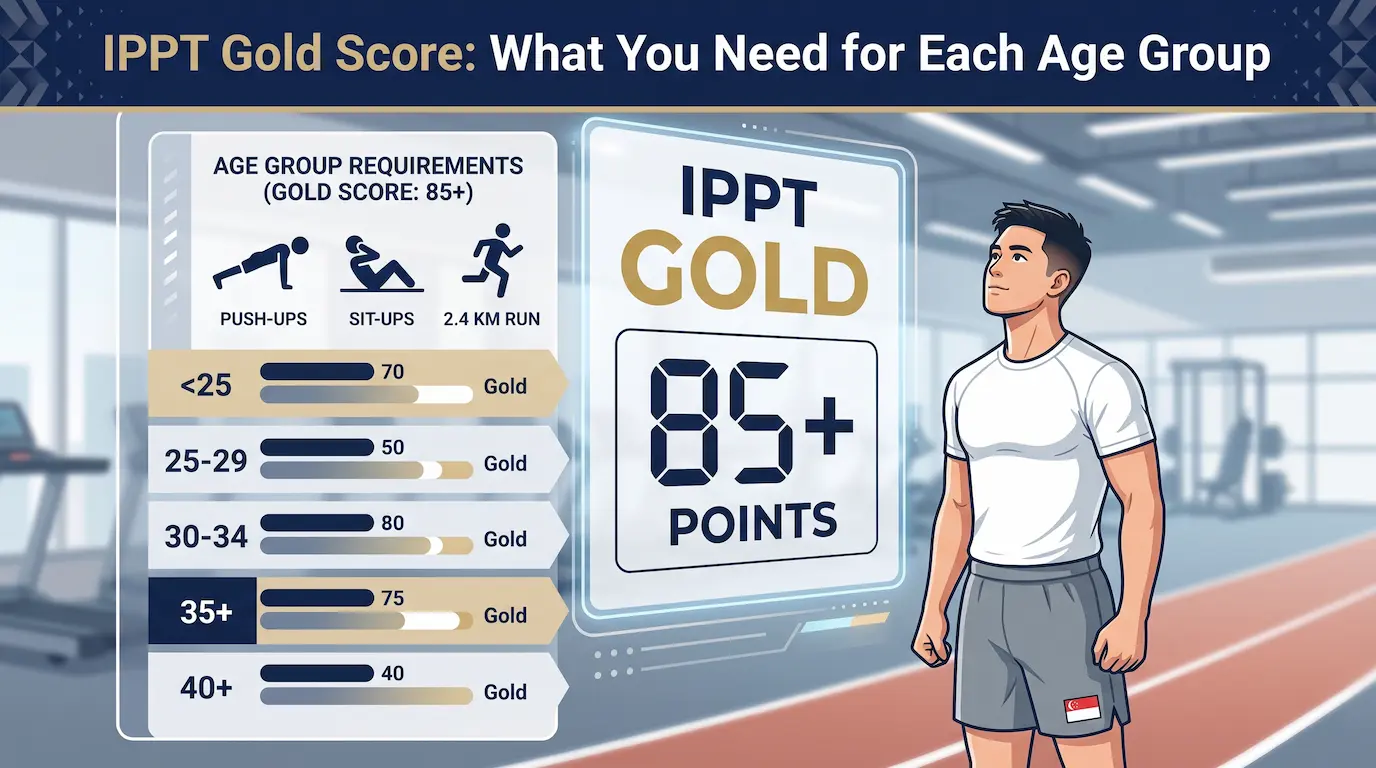
The IPPT Gold score is awarded when you achieve 85 points or more in your Individual Physical Proficiency Test (IPPT).
Your total score comes from:
- Push-ups
- Sit-ups
- 2.4km run
Each component gives you points, and the total determines your award:
- Gold: 85 points and above
- Silver: 75–84 points (see the full breakdown of how many points are usually needed for IPPT Silver).
- Pass: 61–74 points
If you’re new and unsure what IPPT actually means, start with this guide on what IPPT means in Singapore.
IPPT Award Comparison
| Award | Points Required | Typical Reward | Difficulty |
|---|---|---|---|
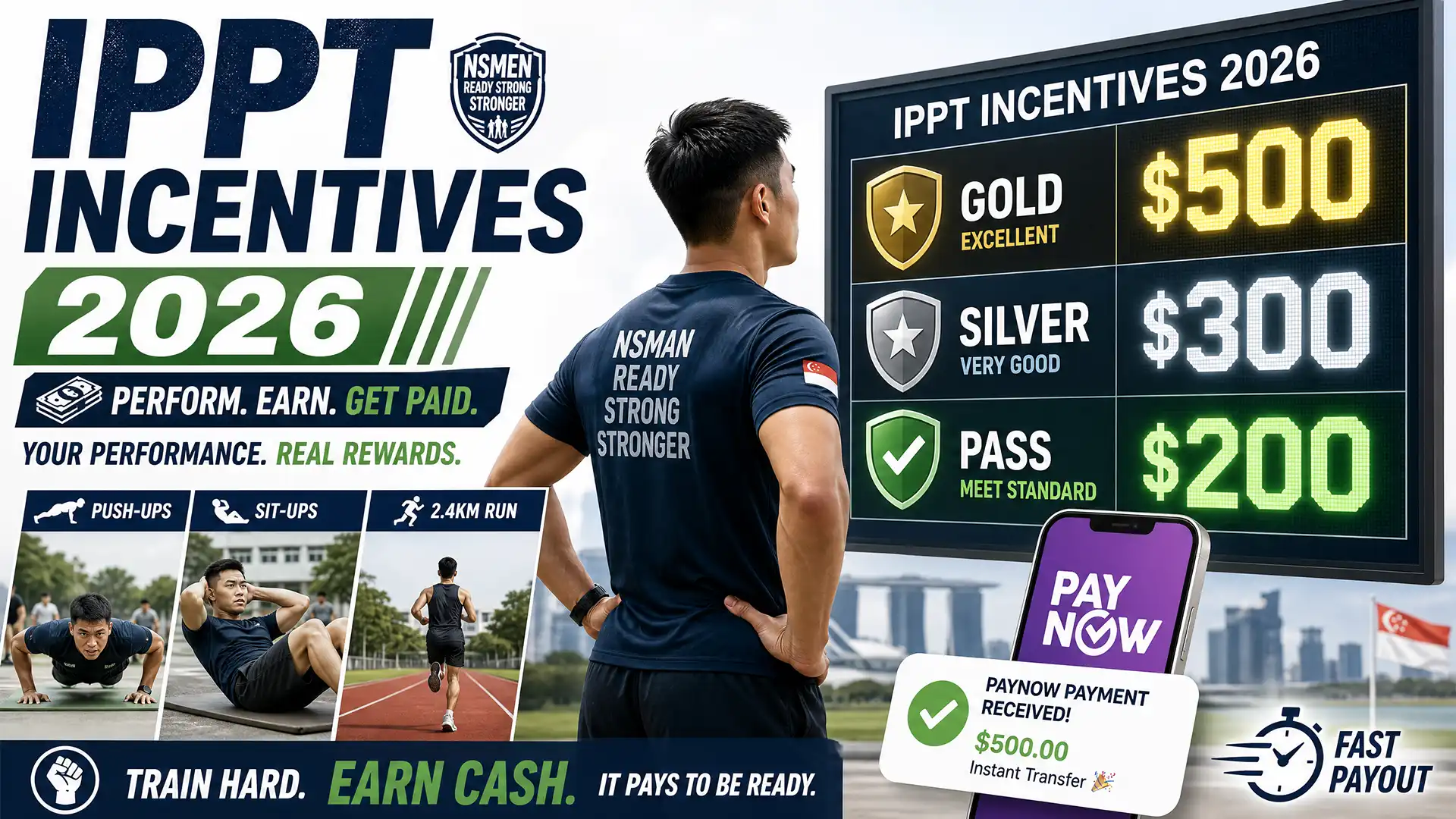
| Gold | 85+ | ~$500 | High |
| Silver | 75–84 | ~$300 | Moderate |
| Pass | 61–74 | ~$200 | Basic |
IPPT Gold Requirements by Age Group (Detailed Table)
Here’s what IPPT Gold typically looks like across different age groups:
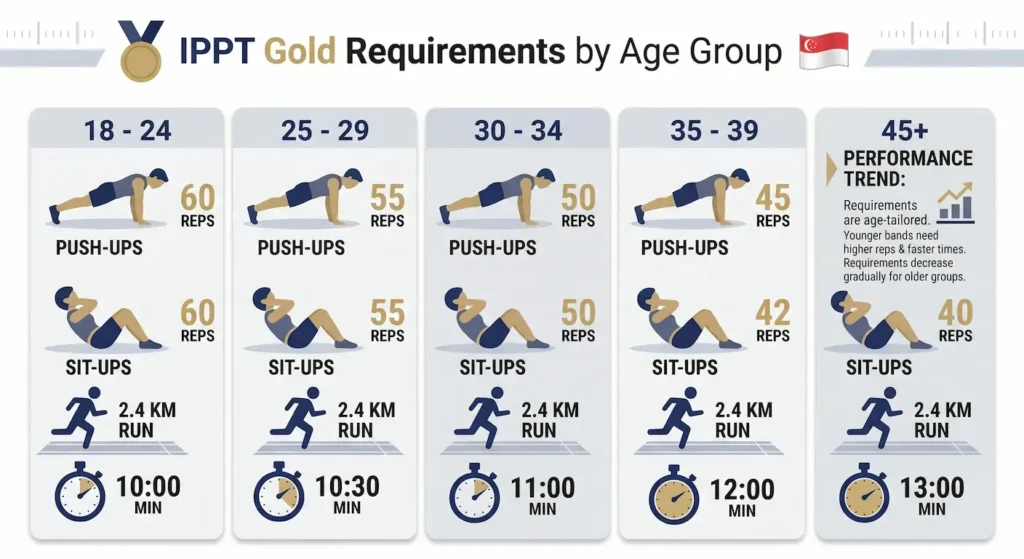
| Age Group | Push-Ups | Sit-Ups | 2.4km Run Time | Notes |
|---|---|---|---|---|
| 18–24 | 55–60 | 55–60 | ~9:00–10:00 | Hardest |
| 25–29 | 50–60 | 50–60 | ~9:30–10:30 | Very demanding |
| 30–34 | 45–55 | 45–55 | ~10:00–11:00 | High effort |
| 35–39 | 40–50 | 40–50 | ~10:30–11:30 | Moderate |
| 40–44 | 35–45 | 35–45 | ~11:00–12:00 | Easier |
| 45+ | 30–40 | 30–40 | ~11:30–13:00 | Much easier |
To check what those benchmarks look like for your exact age and performance level, Use IPPT Calculator
If you want exact scoring per rep and run timing, review the IPPT scoring system guide first, then check the relevant scoring table for your age group.
IPPT Gold Requirements (Push-Ups, Sit-Ups, Run Timing)
To realistically hit Gold, you need strong performance across all three stations.
Here’s a general benchmark (example for ages 25–29):
- Push-ups: ~50–60 reps
- Sit-ups: ~50–60 reps
- 2.4km run: ~9:30 – 10:30
For older age groups:
- Required reps decrease
- Allowed run timing increases
This means:
You don’t need to max out everything — you need balanced scoring
If you’re unsure how these reps and run timings convert into points, read how IPPT points are calculated before you build your Gold plan.
Example – What You Need for IPPT Gold
Let’s make this real.
Example 1: Age 25 Check your Score
- Push-ups: 55
- Sit-ups: 52
- Run: 9:45
Result: Likely Gold
Example 2: Age 35 Check your Score
- Push-ups: 45
- Sit-ups: 45
- Run: 10:30
Result: Still Gold range
Example 3: Age 42 Check your Score
- Push-ups: 35
- Sit-ups: 38
- Run: 11:30
Result: Achievable Gold
If you’re struggling to hit these numbers consistently, read how to ace your IPPT in 7 easy steps for a more practical training structure.
How IPPT Scoring Actually Works?
Each station contributes up to a maximum number of points:
- Push-ups: up to 25 points
- Sit-ups: up to 25 points
- Run: up to 50 points
Total = 100 points
Your age determines:
- How many reps = how many points
- What run timing = how many points
That’s why two people with the same performance can get different scores.
For the full breakdown of point allocation, age-band adjustments, and station weighting, refer to the IPPT scoring system guide.
IPPT Gold Incentives (Why It Matters)
Getting Gold isn’t just about fitness — there’s a real reward.
Typical incentive:
- Gold: ~$500
- Silver: ~$300
- Pass: ~$200
You must also meet the relevant service and incentive conditions, so it helps to review the IPPT eligibility guide before treating Gold as a guaranteed reward outcome.
How to Achieve IPPT Gold Faster?
Instead of maxing out one station, focus on balance:
- Prioritize your weakest station
Most people lose points in the run first, so if pacing or pressure is your biggest issue, read the mental battle of the IPPT 2.4 km run before changing everything else. - Train for consistency, not peak
You don’t need perfect scores, just strong across all 3 - Use scoring strategy
Improving run timing often gives more points than extra reps - Follow a structured plan
If you want a more practical training roadmap, follow how to ace your IPPT in 7 easy steps and build your sessions around the station that gives you the fastest points gain. - Learn from failure
Frequently Asked Questions
The minimum score for IPPT Gold is 85 points. This total comes from your combined performance in push-ups, sit-ups, and the 2.4km run. While the score requirement stays the same across all ages, the number of reps and run timing needed will vary depending on your age group.
Yes, IPPT Gold is considered challenging, especially for younger age groups where the physical requirements are higher. However, it is very achievable with consistent training and a balanced approach across all three stations instead of focusing on just one.
The 2.4km run contributes the most points, with up to 50 points available. Push-ups and sit-ups contribute up to 25 points each. Because of this, improving your run timing usually has the biggest impact on your overall score.
It is possible, but difficult. Since the run carries the highest points, a slow run will significantly reduce your total score. To compensate, you would need very high scores in both push-ups and sit-ups, which is harder for most people.
Yes, IPPT scoring is adjusted based on age groups. Older individuals require fewer repetitions and are allowed slower run timings to achieve the same score. This makes it relatively easier to achieve Gold as you get older.
The number of push-ups needed depends on your age, but generally ranges from 30 to 60 reps for a Gold score. Younger age groups need higher repetitions, while older groups require fewer.
The fastest way to improve your IPPT score is to focus on your weakest station, especially the run. Small improvements in run timing can significantly increase your total points. Following a structured training plan and practicing under test conditions also helps.
If you fail IPPT, you may be required to attend mandatory training sessions such as NS FIT. Failing also means you won’t receive any incentive, which is why many aim for at least a pass or higher. If you want the next-step breakdown, read how NS FIT sessions work in Singapore.
Key Takeaways
- IPPT Gold requires 85+ points
- Requirements change based on age
- You don’t need perfect scores — balance is key
- Run performance often has the biggest impact
- Use proper training instead of guessing
Most people overcomplicate IPPT Gold when it really comes down to understanding how the scoring works for your age and training smart instead of blindly pushing harder. Once you know your realistic targets, it becomes much easier to plan and actually hit Gold without wasting effort. Focus on balanced performance, use the right resources, and you’ll find that reaching IPPT Gold is far more achievable than it first seems.