TL;DR
Silver has traditionally been the 75-84 point band, but the official scoring tables are the final source – check them for the current boundaries before you train. Use the IPPT calculator to test combinations of push-ups, sit-ups and run time that reach Silver for your age band. Small changes near table cutoffs often give +1 point and can be the fastest route from Pass → Silver.
Silver is normally a mid-high award band – historically 75-84 points – but award bands can be adjusted when MINDEF updates the scoring tables. Always confirm the current IPPT scoring table for your age band before locking a training plan. Use the IPPT score calculator right away to see what small gains you need to reach Silver.
(Note: official scoring mechanics and point maxima are defined by MINDEF; check MINDEF and the official tables for exact award cutoffs).
What Is Silver?
The IPPT Silver score is the performance band above the basic pass level in the IPPT fitness test.
Numeric boundaries for Silver
Silver has commonly been reported as the 75-84 point band in many scoring references, but award boundaries are defined by the current official scoring tables and have been refined in recent updates. Do not rely on memory – check the official table for your age band before you set a target. For a full breakdown of how station points are added, how award bands work, and how totals are calculated, see the IPPT scoring system guide.
Why I say “check the table”: MINDEF has refined scoring to smooth point distribution, and some calculator sites report new award boundaries in recent updates. Always treat the official table as the source of truth.
Why Silver matters (incentives, recognition)
Silver is an important target for many NSmen because it shows solid fitness beyond the pass band and may carry recognition or incentive value within certain units or schemes. Hitting Silver often places you in a safer zone – fewer retakes, less stress, and visible progress toward Gold if you decide to push further. Where monetary or award incentives are listed, verify amounts and eligibility with official notices or your unit.
If you are still working from basic pass level and want to understand the exact threshold first, read our guide on the IPPT passing score and the points you need to pass.
Combinations That Reach Silver
You reach Silver by summing station points to hit the Silver band for your age. If you want to understand how those points are distributed across each station and why certain combinations work better than others, check the IPPT scoring system guide. There are many valid combinations – strong run + moderate reps, or high reps + a decent run. Use the calculator to find the most time-efficient route for your profile.
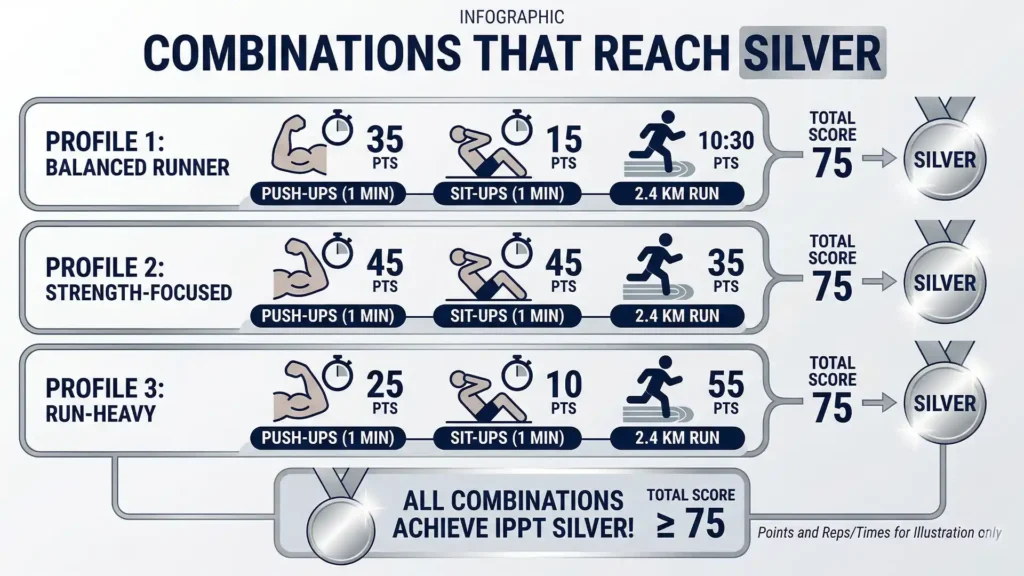
Three example combos for common age bands
Below are illustrative combos used to plan training. Do not treat these as the table – they are examples to show how different strengths combine. Always confirm with the official table for your exact age band.
| Example (male, illustrative) | Push-ups | Sit-ups | 2.4 km run | Approx. points | Result |
|---|---|---|---|---|---|
| Balanced runner | 30 | 30 | 11:45 | ~75 | Silver (typical) |
| Strength focus | 40 | 40 | 13:00 | ~78 | Silver |
| Run-heavy | 20 | 25 | 10:30 | ~76 | Silver |
(These combos are for planning only. Use the IPPT score calculatorand the official IPPT scoring tables to get exact points for your age band.)
Training Strategy To Move From Pass → Silver
Choose the station that gives the best points-per-hour for your current level – practice small, measurable gains (e.g., +3 reps or −6 seconds) and use structured blocks (8 weeks) mixing reps and run work.
8-week plan split: run vs reps focus (practical plan)
Weeks 1-2: baseline and form correction – test and record current reps/times, refine push-up/sit-up form.
Weeks 3-6: build volume – 3 strength sessions per week (push/sit circuits) + 2 run sessions (intervals, tempo).
Weeks 7-8: sharpening – reduce volume, do race-pace runs and test reps under fatigue.
Use progressive overload: add small weekly increases (2-4 reps, 5-10 seconds off run).
If you want a simpler and more practical training framework, read our guide on how to ace your IPPT in 7 easy steps for workout structure, pacing, and recovery ideas.
Common mistakes (overtraining, ignoring recovery)
Pushing too hard without recovery causes form breakdown and lost repetitions. Ignoring test-style practice (timed 1-minute reps, run pacing) can leave you unready for the test format. Include at least one full-speed mock test every 2-3 weeks to track real progress.
Silver vs Gold
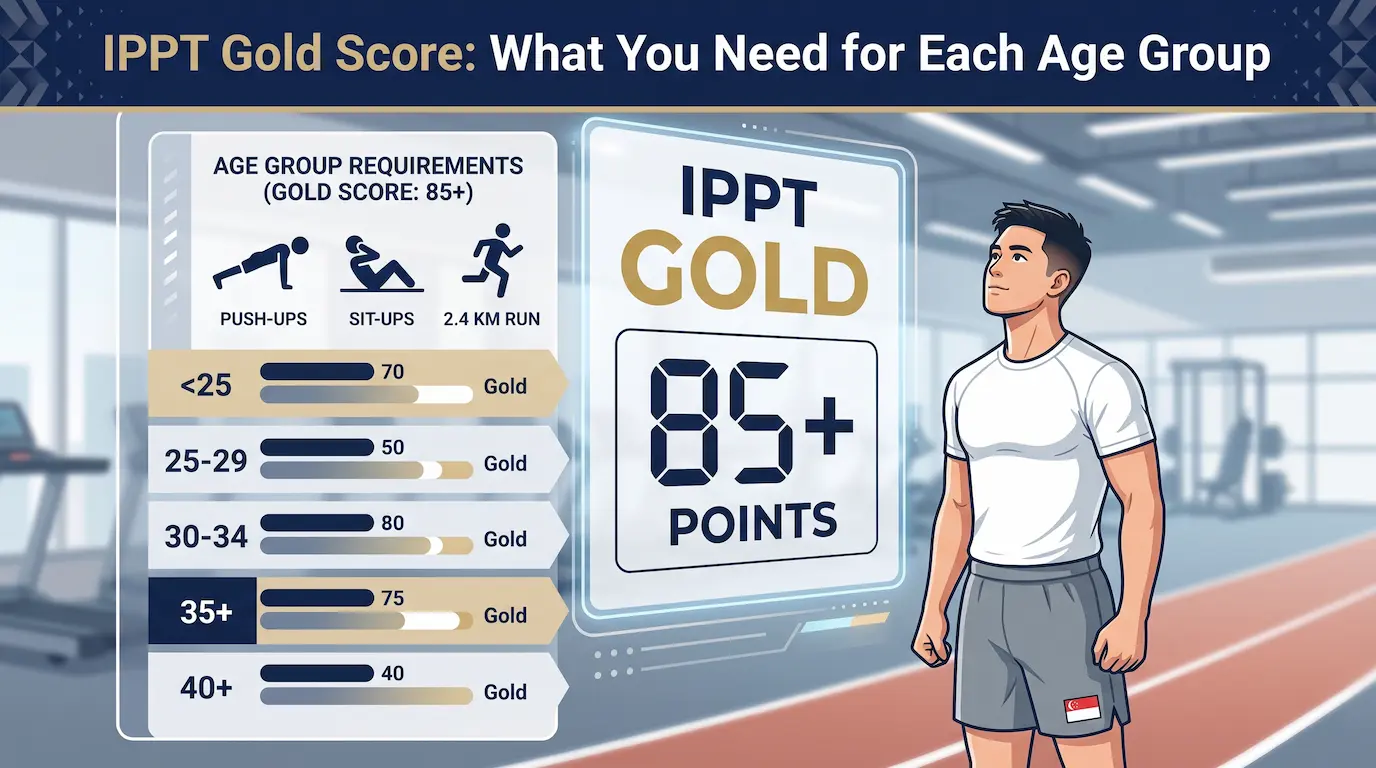
Silver is the stable intermediate award; Gold requires higher totals (often 85+ historically). Choose Silver if you have limited training time or want a safer, achievable target this cycle.
| Award | Typical Points Range (historical) | When to target |
|---|---|---|
| Pass | 51-60 (or 51-74 in older schemes) | New NSmen / short prep |
| Silver | 75-84 (historical) | Solid target for steady training |
| Gold | 85-100 | For high-level athletes or extended prep |
Note: Award bands and incentive schemes have been refined in recent years; verify current award cutoffs on the official table.
FAQ
Historically, Silver has usually sat around 75 to 84 points, but you should confirm the current boundary using the official tables and the IPPT scoring system guide before you set a target.
Yes – if your push-ups and sit-ups are strong enough to add the required points. Use the IPPT calculator to test combinations and find the most efficient route.
A focused 6-8 week plan with consistent strength and interval work is realistic for many NSmen, depending on starting fitness and injury history.
Incentive schemes change; check your unit notices or official announcements for current incentive details and eligibility.
It varies by age band and station. Rough heuristic: +2-4 reps for push-ups/sit-ups and −6 to −10 seconds on the run near band cutoffs. Always verify with the official tables.
Final checklist before you book
- Check the current official IPPT scoring table for your age band.
- Enter your numbers into the IPPT score calculator and save the result.
- Simulate small changes (+2-4 reps, −6-10 seconds) to see which station gives the best points per training hour.
- Pick an 8-week plan based on that priority and include mock tests every 2-3 weeks.
- Recheck the scoring table and re-simulate one week before booking.
The official tables published via MINDEF/OneNS/CMPB are the final authority on award bands and scoring rows; use them for exact cutoffs and any incentive rules.