IPPT Scoring System (50/25/25 Framework Explained)
Many people taking the IPPT struggle with one thing: they do not fully understand how the scoring system works, why the 50/25/25 model matters, or what actually determines a pass, fail, or award. This creates uncertainty when reading calculator results, planning training, or preparing for annual compliance.
IPPT Scoring System – Quick Summary
Total score
100 points
Station weighting
2.4 km run (50), Push-ups (25), Sit-ups (25)
Pass mark
51 points
Zero score in any station
= Automatic fail
Age and gender change performance requirements, not the 51-point pass mark.
Same scoring applies to NSF, NSmen, Pre-Enlistees
This guide removes all confusion by explaining the scoring framework in clear, practical terms so you know exactly how every station contributes to your total. It also breaks down zero-score rules, age-band adjustments, and service-group differences so you’re not left guessing how your performance is interpreted.
If you want to apply this scoring framework to your own push-ups, sit-ups, and run timing, use the IPPT score calculator to estimate your total instantly.
Go to IPPT CalculatorIPPT Scoring Framework Overview
The IPPT scoring system uses a fixed 100-point scale across three stations: push-ups, sit-ups, and the 2.4 km run. Each station adds its own points to the total, and there are no averages or special adjustments. Together, the stations measure overall fitness in endurance, upper-body strength, and core stability across NSF, NSmen, and Pre-Enlistees.
IPPT has been a long-standing fitness test within National Service. It checks three main areas that matter for operational readiness: upper-body strength, core endurance, and running performance. The test follows clear rules, minimum station requirements, and scoring tables that change by age and gender to reflect realistic performance levels.
The scoring structure stays the same for everyone, but the exact number of points earned depends on the user’s age band and gender. Knowing these basics makes it much easier to read calculator results, review past attempts, and understand pass, fail, or award outcomes. If you want a simpler example-led walkthrough, read how IPPT points are calculated before comparing your own station results.
IPPT calculator can help estimate scores using publicly available performance tables. These estimates are helpful for planning, but only official test sessions run by SAF determine the final outcome, based on verified repetitions and run timings.
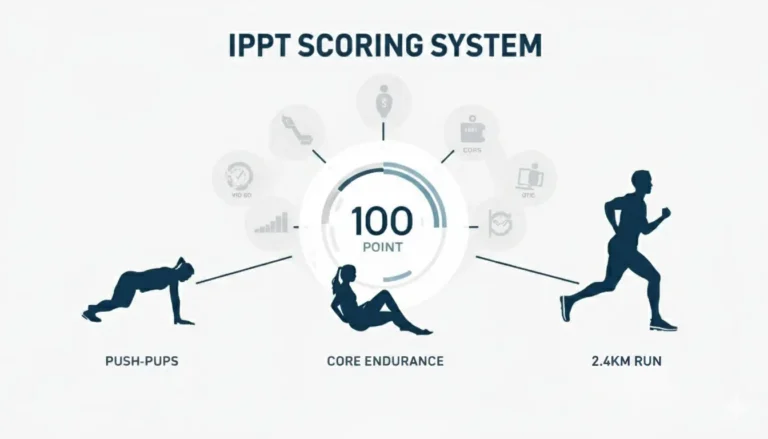
The 50/25/25 Station Weighting Model
-
Purpose of the IPPT
IPPT adopts a fixed 50/25/25 weighting model that gives the 2.4 km run the largest impact on the total score. Push-ups and sit-ups contribute 25 points each. This structure reflects the operational emphasis on sustained endurance while ensuring balanced strength assessment. All three stations are compulsory, and performance in one cannot compensate for a zero-score in another.
-
Purpose of the IPPT
The 50/25/25 model is central to how the IPPT maintains fairness and consistency. By anchoring the majority of points in the 2.4 km run, the framework mirrors the endurance expectations commonly associated with military readiness and field performance. At the same time, strength stations protect against imbalanced performance and ensure that core strength and upper-body strength are not neglected.
How Are IPPT Points Distributed Across the Three Stations?
| Station | Maximum Points | Fitness Component Measured |
|---|---|---|
| 2.4 km Run | 50 | Cardiovascular endurance |
| Push-Ups | 25 | Upper-body strength |
| Sit-Ups | 25 | Core strength |
| Total | 100 | Overall physical fitness |
The weighting is not adjustable for any individual or service group. It is the anchor of the entire scoring ecosystem and governs how all subsequent interpretations, thresholds, and awards are derived.
Comparison: IPPT vs Other Military Fitness Tests
A comparison helps clarify why the 50/25/25 model looks different from tests used by other militaries. IPPT focuses on simplicity, standardisation, and scalability across a nationwide NS population.
| Feature | IPPT (Singapore) | US Army ACFT | UK Annual Fitness Test | Australian BFA |
|---|---|---|---|---|
| Stations | Push-ups, sit-ups, run | 6 stations (strength + power + endurance) | 2 km loaded march | Push-ups, sit-ups, run |
| Scoring | 100-point, 50/25/25 | 600-point multi-event | Pass/fail | Points per station |
| Complexity | Low | High | Moderate | Low |
| Equipment | None | Extensive | Load-bearing gear | Minimal |
| Zero-Score Rule | Yes | Not applicable | Pass/fail | Yes (minimum performance) |
| Population Fit | Mass-testing | Active-duty soldiers | Combat units | Mixed |
Interpretation
The IPPT model is intentionally:
Simpler
Faster to administer
Easier for public-facing calculators
More scalable for annual compliance
Yet it still measures the core military domains efficiently.
How total IPPT scores are calculated?
Your IPPT total score is the sum of the points earned from all three stations. Each station’s score depends on your age band, gender, and raw performance inputs. The calculation has no modifiers, bonuses, or adjustments beyond the official tables. A valid score must include non-zero performance in every station.
The scoring process is mechanical and transparent:
Calculation Steps
Each completed station generates a point value using official tables.
All three station scores are added.
The sum produces a total score out of 100.
No post-test adjustments are applied.
Scores cannot be averaged, rounded, or manually modified.
This consistency ensures IPPT calculator outputs match official expectations as closely as possible, provided the inputs are entered accurately.
| Station | Performance | Points Earned |
|---|---|---|
| Push-Ups | 40 reps | 18 pts |
| Sit-Ups | 45 reps | 23 pts |
| 2.4 km Run | 12:30 | 42 pts |
| Final Total | – | 83 pts |
This score would typically fall into the Pass with Incentive or Silver category depending on the exact award thresholds for the user’s demographic.
Check Your IPPT Score with the CalculatorAge Bands and Gender-Based Scoring Adjustments
IPPT uses age and gender adjustments to ensure fairness across the National Service population. Younger participants generally require stronger performance for the same points, while older age bands receive incremental threshold relief. Gender-based scoring differences exist but follow the same scoring logic and station weighting.
Different age groups reflect natural physiological changes over time, and the SAF scoring tables are designed to align expectations with realistic performance norms. These adjustments do not change the scoring structure or the pass mark – they only alter the raw performance required to hit specific point values.
How Age and Gender Influence Scoring?
Younger participants must complete more repetitions or run faster for the same point level.
Older age bands receive adjusted thresholds for strength and endurance.
Female scoring tables have separate performance lines with matching total score structure.
All demographic categories still follow the 50/25/25 weighting model.
Example Comparison Across Age Bands
| Age Band | Push-Ups for 22 pts | Sit-Ups for 22 pts | Run Timing for 42 pts |
|---|---|---|---|
| 21–23 Male | ~47 reps | ~53 reps | ~12:40 |
| 34–36 Male | ~41 reps | ~49 reps | ~13:20 |
| 40–42 Male | ~35 reps | ~46 reps | ~13:50 |
These numbers are approximations for illustration and not substitutes for official tables.
Scoring Consistency Across NSF, NSmen, and Pre-Enlistees
The IPPT scoring system is identical for full-time National Servicemen, operationally ready NSmen, and Pre-Enlistees. All groups follow the same point tables, pass mark, and zero-score rules. Administrative pathways differ, but scoring logic and thresholds do not.
If you are unsure which service groups are actually required to take IPPT in the first place, check the IPPT eligibility guide.
The SAF uses a unified scoring framework to ensure uniform expectations across service classifications. Performance results determine different administrative actions depending on whether the participant is full-time, operationally active, or preparing for enlistment.
Comparative Impact Across Service Groups
NSFs: Scores may influence training progression and readiness assessments.
NSmen: Outcomes affect compliance windows, NS FIT eligibility, and remedial requirements.
Pre-Enlistees: Results prepare candidates for future training and signal enlistment preparedness.
Administrative Comparison Table
| Group | Scoring Logic | Administrative Impact |
|---|---|---|
| NSF | Same | Training progression, unit expectations |
| NSmen | Same | Compliance status, RT/NS FIT pathways |
| Pre-Enlistee | Same | Pre-enlistment readiness |
Pass Mark, Awards, and Outcome Thresholds
The IPPT pass mark is 51 points. If your main concern is simply clearing the minimum threshold, read our guide on the IPPT passing score and the exact points you need to pass. Scores below this threshold result in failure regardless of strength in individual stations. Higher combined scores qualify for tiered awards such as Incentive, Silver, and Gold. If you are aiming above the basic pass level, see how many points are usually needed for IPPT Silver before you plan your training target. Award thresholds vary by age and gender but follow the fixed 100-point scoring structure.
What Total Scores Lead to Pass, Fail, or Award Outcomes in IPPT?
| Total Score | Outcome Classification |
|---|---|
| Below 51 | Fail |
| 51 and above | Pass |
| Higher Thresholds | Incentive / Silver / Gold |
All award categories require valid non-zero performance across all stations. Even a strong endurance run cannot compensate for a zero in a strength station.
The Zero-Score Rule and Automatic Failure
A zero score in any IPPT station triggers automatic failure. This rule applies when a participant performs zero valid repetitions or fails to complete the 2.4 km run. No combination of strong performance in other stations can offset this. The rule protects balanced fitness and ensures minimum competency in all domains.
“The zero-score rule is non-negotiable and overrides total point calculations.”
Zero-Score Scenarios
Push-ups: No valid reps recorded
Sit-ups: No valid reps recorded
2.4 km run: Run not completed
The rule applies to all demographics and service groups without exception.
Example: Zero-Score Impact
A participant who earns:
Push-Ups: 23 pts
Sit-Ups: 24 pts
Run: 0 pts
Final Outcome = Fail, regardless of total potential score.
Compliance Outcomes and Next Steps After Testing
IPPT results determine follow-up actions such as NS FIT eligibility, remedial training requirements, and the timing of repeat attempts. Scoring does not change across administrative pathways, but post-test obligations depend on the recorded outcome and the participant’s service group.
If you want to understand how those repeat attempts fit inside your yearly compliance cycle, review the IPPT window annual requirements.
Common Follow-Up Pathways
Assignment to NS FIT for NSmen
Scheduled Remedial Training for repeated failures
Retests within the mandated compliance window
Unit-based actions for full-time NSFs
If NS FIT is the likely next step after a failed result, this guide explains how NS FIT sessions work and what to expect.
Comparative Administrative Logic
| Outcome | NSF Impact | NSmen Impact | Pre-Enlistee Impact |
|---|---|---|---|
| Fail | Training review | NS FIT/RT | Advisory only |
| Pass | Meets standard | Compliant | Prepared |
| Award | Recognition | Monetary incentive (if applicable) | Not applicable |
Actual requirements depend on official notifications from MINDEF and unit commands.
If you are unsure whether you are required to attempt IPPT this year, start with the IPPT eligibility guide. If your concern is specifically about failing and what that triggers next, the IPPT fail guide explains the likely administrative consequences more clearly.
What Happens After IPPT Based on Your Score and Service Group?
This table provides a fuller view of how IPPT calculator results affect each service category. Scoring logic is identical; only administrative consequences vary.
| Score Outcome | NSF | NSmen | Pre-Enlistee |
|---|---|---|---|
| Fail (0–50) | Unit oversight; training review; may attend structured fitness sessions | Assigned to NS FIT or RT depending on number of past failures | Advisory only; no punitive action |
| Pass (51–60+) | Meets minimum standard | Fully compliant; no further action | Indicates acceptable readiness |
| Incentive Tier | Recognition; internal commendation | Monetary incentive (if eligible) | Not applicable |
| Silver / Gold | Strong performance; positive impact on unit readiness | Higher incentive tiers; reflects high fitness | Signals strong pre-enlistment conditioning |
| Zero-Score in any station | Automatic fail; training review | Automatic fail; leads to NS FIT/RT | Treated as non-completion; advisory outcome |
Practical Interpretation and Score Understanding for Candidates
Understanding the scoring structure helps participants evaluate their strengths, identify weaknesses, and interpret calculator results accurately. Balanced performance across all three stations is essential. Endurance alone cannot offset a zero in a strength station, and strong strength performance cannot neutralise poor run timing.
Key Interpretation Points
Maintain minimum competency in all stations.
Optimise strong stations but avoid relying on them exclusively.
Use age-band tables for realistic performance targets.
Review previous scores to identify predictable gaps.
Example of Misinterpretation
A participant might believe that an excellent run time can “save” their overall result. Under the zero-score rule, this is not possible. Even a near-Gold run timing cannot compensate for zero push-ups.
Conclusion
The IPPT scoring system is easy to understand once you know the basics. Your result comes from push-ups, sit-ups, and the 2.4 km run, with the run carrying the most points.
The pass mark is always 51, and a zero in any station means an automatic fail. Age and gender only change the performance needed for points, not the score required to pass. When you understand these rules, it becomes much easier to read your results, plan your training, and avoid surprises on test day. A balanced approach across all stations is the safest way to pass consistently. To see how your current push-ups, sit-ups, and run timing add up under the official framework, use the IPPT calculator before your next booking or training block.
Common Misunderstandings About the IPPT Scoring System
Many IPPT misconceptions come from partial information or outdated assumptions. Clarifying these points helps candidates interpret their results accurately and avoid incorrect expectations.
Myth: A fast 2.4 km run can compensate for weak push-ups or sit-ups.
Reality: A zero score in any station results in automatic failure, regardless of performance in other stations. Balanced performance across all three stations is mandatory.
Myth: NSmen have easier scoring standards than NSFs.
Reality: The scoring system, station weighting, and pass mark are identical across all service groups. Differences apply only to administrative follow-up, not scoring rules.
Myth: Age lowers the IPPT pass mark.
Reality: The pass mark remains fixed at 51 points for all age groups. Age adjustments affect performance thresholds, not the minimum score required to pass.
Myth: Passing one year guarantees future compliance.
Reality: IPPT compliance applies only within the active window. Each new cycle requires a valid attempt or completion of NS FIT requirements
Frequently Asked Questions (IPPT Scoring)
These FAQs address common scoring uncertainties, including pass mark interpretation, zero-score implications, and the status of online calculator outputs. Each answer reflects publicly available guidance and avoids speculation beyond official scoring processes.
Trust & Accuracy Note
This article is based on publicly available National Service guidance and the established IPPT scoring framework. Official outcomes depend on actual test performance, administrative decisions, and notifications from authorised SAF or MINDEF systems