TL;DR
Points come from age-banded tables: push-ups (max 25), sit-ups (max 25) and the 2.4 km run (max 50). Small changes near table thresholds often give +1 point. Use the IPPT calculator to convert your reps and run time into points before you book a test.
IPPT points are read from official age-band tables and added across three stations to give your final score. Each rep or second maps to a point band that varies by age. Small gains – a few reps or seconds – commonly shift you to the next point, so testing with the IPPT score calculator helps you decide what to train first.
How The Scoring Tables Work?
The scoring tables map exact reps or run times to point values by age band; adding the three station values gives your total IPPT points.
The tables are the authoritative source for converting performance into points, so always check the table for your age band before estimating. According to MINDEF IPPT guidance, the official tables define the exact rep/time thresholds for every point. For a full explanation of how station points are assigned, how totals are added, and how award bands are determined, see the IPPT scoring system guide and check IPPT scoring tables for men or women for exact rows.
Reading the Push-Ups Table (how reps map to points)
First line: push-ups map reps to 0-25 points; each age band has different rep cutoffs. Read the row that matches your age to see how many reps equal each point. Small changes near a cutoff – often 2-4 reps – will move you up one point in mid bands, so practice near those cutoffs to gain points fast. For the exact push-up rows, see IPPT scoring table for men (ippt-scoring-table-for-men).
Reading Sit-Ups & Run Tables
First line: sit-ups work like push-ups: reps → points, with banded cutoffs that differ by age. The 2.4 km run maps times to points; faster times give more points up to 50. Always check the table for your band because the seconds/reps per point vary with age; use IPPT scoring tables for women if that applies to you.
Heuristics: “How Much = +1 Point?”
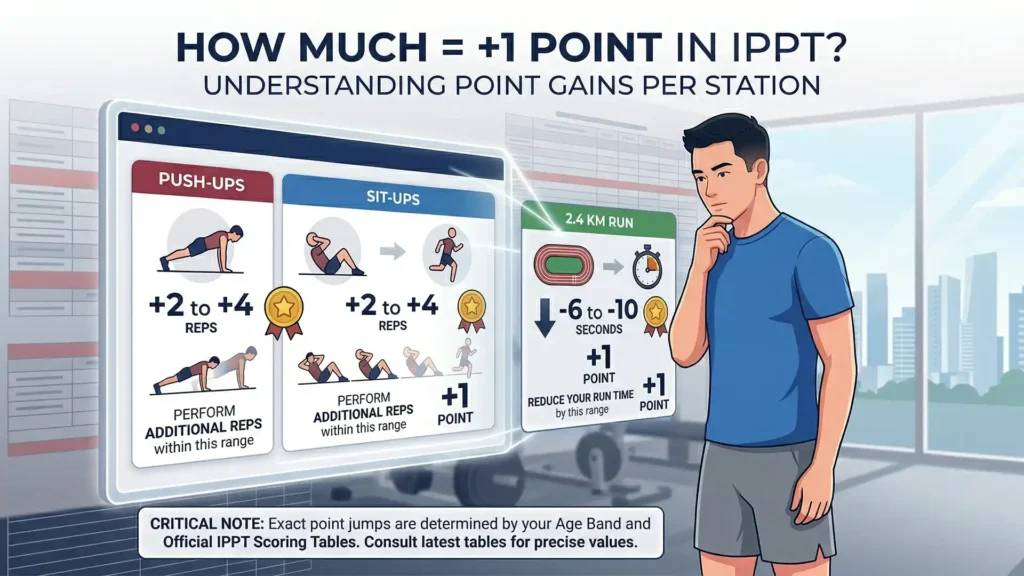
Heuristics help you plan training when you can’t memorise full tables – typical +1 rules are: push-ups ≈ +2-4 reps, sit-ups ≈ +2-4 reps, run ≈ −6 to −10 seconds for one point near mid bands. These are rules of thumb only; always verify with the official table for your age band. If you want to understand why point jumps vary by age and station, check the IPPT scoring system guide before you plan your training around these heuristics.
Use the calculator to simulate small changes and see which station gives the fastest return on training time.
Push-Ups: Typical +1 ≈ 2-4 Reps
First line: around the middle of most age bands, adding two to four correct push-ups often gives one extra point. If you are several points short, improving push-ups is efficient because reps are easy to train and count. But confirm with your age row in the IPPT scoring table for men (ippt-scoring-table-for-men) to be exact.
Sit-Ups: Small Reps Often Add Points
First line: similar to push-ups, adding two to four sit-ups near a cutoff often yields one point. Practice consistently and focus on full range, not speed alone, to make reps count in the test.
Run: Typical +1 ≈ 6-10 Seconds
First line: in many age bands, shaving about six to ten seconds from your 2.4 km time near a boundary gains roughly one extra point. Run gains are high-leverage because the run carries up to 50 points, but improving running time can take longer than adding a few reps. If the 2.4 km run is where you keep losing points, read our guide on the mental battle of the IPPT 2.4 km run and how to manage pacing pressure better. Always confirm exact seconds per point in your age row of the run table.
If you need a quick simulation, use the IPPT score calculator now to test whether extra reps or a faster run gives you the best points per training hour.
How To Use The Calculator?
Enter your age, correct push-up reps, sit-up reps, and your 2.4 km run time into the IPPT calculator to see the exact points each station gives and the total score. If your main concern is simply clearing the minimum threshold first, read our guide on the IPPT passing score and the exact points you need to pass. If your target is Silver rather than just a pass, check our guide on how many points are usually needed for IPPT Silver.
Step-by-Step: Enter Age, Reps, Run Time – Get Points
- Open the IPPT score calculator and select your age band.
- Enter counted correct push-ups, then sit-ups, then your 2.4 km time in minutes:seconds.
- Review the points per station and the combined total; the calculator highlights which station is closest to the next point. Save the result as your baseline.
Use-Case: “I Need +3 Points – What To Prioritise?”
First line: run the calculator with your current numbers and then with small changes (for example +3 push-ups, +6 sit-ups, −8 seconds run) to see which option adds the most points. If +3 push-ups gives +2 points and −8 seconds gives +3 points, focus on running workouts. The calculator lets you test realistic scenarios before you commit training time.
FAQ
Points are read from official age-band tables that map reps and run times to 0-25 (push-ups), 0-25 (sit-ups), and 0-50 (run). For the full breakdown, see the IPPT scoring system guide.
There’s no single number – near mid bands it is often about two to four extra correct push-ups for one point; check your exact age row in IPPT scoring tables (ippt-scoring-table-for-men).
It varies by age band, but a good rule is roughly six to ten seconds per point near mid bands; verify with the run row in the scoring table.
Yes. The calculator uses the official tables to convert your reps and run time to points – it shows exact station points and the combined total.
Yes. All tables shift with age bands, so the reps/seconds per point change as you move into older bands.
Final Checklist Before You Book:
- Confirm your age band and check the relevant scoring table.
- Test current numbers in the IPPT score calculator and save the result.
- Simulate +2-4 push-ups, +2-4 sit-ups, and −6 to −10 seconds run to see which gives the fastest points gain.
- Pick a training plan focused on the station that gives the best points per hour.